


Who is Telling Robert Owen’s Story? By Yingduo Wang

Part of a series of student articles for the Schaeffer Fine Arts Library Internship Program
Find out more about our Master of Art Curating or Master of Museum & Heritage Studies
Art history is often understood as the history of artists and their works. However, as we step into the archives, we gradually come to realise that an artist’s story does not simply exist in isolation but is shaped through the constant retelling and reinterpretation of diverse perspectives. The exhibition Who is Telling Robert Owen’s Story? explores precisely this question: When we think of the Australian artist Robert Owen today, where does our understanding of “Robert Owen” actually come from? And who is telling his story?
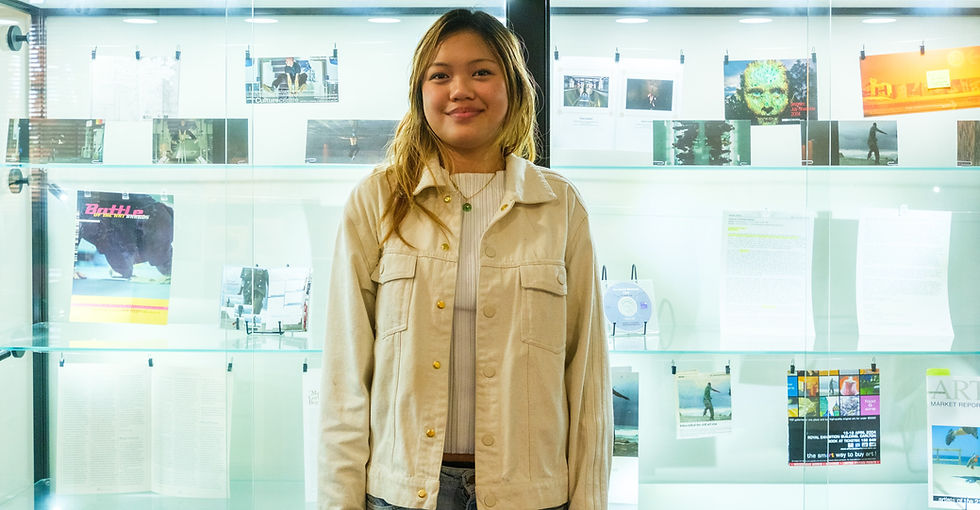
The exhibition draws on archival materials from the Sherman Galleries Collection held at the Schaeffer Fine Arts Library. Through the display of exhibition catalogues, invitations, journal articles, promotional materials, and related archival documents, it seeks to trace the evolution of Robert Owen’s artistic image. This exhibition does not seek to provide a definitive answer regarding the artist, but rather aims to invite audiences to reflect on how the artist’s image is progressively constructed, negotiated, and disseminated among institutions, critics, the media, and the artist themselves.
In the public imagination, an artist’s identity seems to derive from their artwork itself. Nevertheless, during actual research, the artist’s image as perceived by the audience often stems not merely from the artwork itself, but from the vast body of texts and archival materials surrounding it. When audiences enter the exhibition, the first thing they see is introductory material about Robert Owen. These materials include exhibition invitations, artist biographies, and related publications. They constitute the primary source of information through which most audiences first encounter the artist. In these materials, the artist’s life story, major exhibitions, and creative achievements are organised into a clear and coherent narrative. Yet this narrative is not solely a straightforward compilation of objective facts.
Whether in gallery descriptions or publication introductions, there are always choices and omissions involved. Certain experiences are highlighted, while certain periods are overlooked; certain keywords are constantly repeated, while other topics increasingly fade from public view. These materials began to transform the artist from a real person into a cultural figure with a specific public image.

Even when faced with the same body of work, different critics often offer vastly different interpretations in the process of archiving folders. While there is consensus among the various commentaries, there are also clear differences. These differences remind us that art history is not a record of a single voice, but rather the result of an ongoing interplay of multiple perspectives. Critics, curators, and scholars all contribute to shaping the artist’s image from their respective perspectives. Over time, certain assessments are repeatedly cited and progressively become part of the mainstream narrative, while other viewpoints may be forgotten. The juxtaposition of different interpretations demonstrates to the audience the inherent openness of art criticism. Robert Owen is not a static entity, but one that is constantly being interpreted and redefined.
Furthermore, galleries are not only spaces for exhibitions of artworks, but also important venues for the construction of art historical narratives. From the design of invitation cards to the writing of exhibition catalogues, and from the publication of media announcements to media outreach, every step contributes to the construction of the artist’s public image.
Those documents that appear to be merely supplementary are of great significance. The content in exhibition catalogues, the visual design in promotional materials, and the key terms used in media coverage collectively form the framework through which viewers understand the artist. These materials are not neutral vehicles of information, but rather cultural discourses with explicit communicative purposes. They assist artists in gaining public recognition and also influence how the public perceives their creative practices. What the audience witnesses is not limited to Robert Owen’s artistic practice, but the cultural narratives that have continually emerged around it.
For me, one of the most important takeaways from this exhibition was a renewed appreciation for the value of archival materials. Before participating in the internship program, I primarily regarded the archives as research materials. But as I worked on the exhibition, I gradually came to realise that the archives themselves can also be the subject of the exhibition.
When curated exhibits, I constantly consider which materials best support the exhibition’s theme and how to create a clear narrative structure within the limited space of the display cases. Every choice involves making a trade-off. Which documents are displayed and which are concealed; which stories are highlighted and which perspectives are downplayed. These decisions all determine the understanding the audience ultimately gains. During my internship, I was involved in a significant amount of archival organization and research work. In contrast to traditional works of art, archival materials often lack immediate visual impact. Their value only becomes apparent through careful reading and background research.
When first faced with a large volume of documents, I often focus on the most obvious information. As my research progressed, I began to examine the connections between documents, consider the contexts in which they were produced, and reflect on the institutional networks behind them. This process has taught me that archival research is not just the search for answers, but the continuous process of asking questions. Why was this document preserved? Why is another document missing? Who has the power to record history? Whose voices are preserved, and whose are ignored? These questions not just impact archival research, but they also affect our understanding of art history.
Who is Telling Robert Owen’s Story? is not a comprehensive account of Robert Owen’s life and work, but rather an exploration of narrative, archives, and the construction of art history.
Through the archival materials on display, audiences can observe how the artist’s image is continually shaped by various actors. Artists, critics, galleries, the media, and scholars have all contributed to the formation of the Robert Owen we know today. Archives are not static historical relics, but cultural resources that continue to engage with contemporary discourse. Every act of reading, exhibiting, and interpreting them constitutes a retelling of history. Therefore, when we ask once again, Who is Telling Robert Owen’s Story? the answer may not be a single person or institution, but rather everyone involved in the narrative. The exhibition itself has also become part of this ongoing narrative.
Acknowledgements
I would like to express my sincere gratitude to the team of Schaeffer Fine Arts Library or their generous assistance and support throughout the development of this project.
In particular, I would like to thank Mr. Sajid Foazdar and Mr. Nicholas Keyzer for their guidance, expertise, and assistance in accessing and navigating the artist archival materials. Their knowledge of the collection and willingness to provide support were invaluable to the research and curatorial development of this exhibition proposal. Their contribution has greatly enriched my understanding of the archive and made the internship and project possible.
Bibliography
Bowker, Geoffrey C., and Susan Leigh Star. “Introduction: To Classify Is Human.” Essay. In Sorting Things Out: Classification and Its Consequences, 1–32. Cambridge, Massachusetts: MIT Press, 1999. https://doi.org/10.7551/mitpress/6352.003.0002.
Derrida, Jacques, and Eric Prenowitz. “Archive Fever: A Freudian Impression.” Diacritics 25, no. 2 (Summer 1995): 9–63. https://doi.org/https://doi.org/10.2307/465144.
Jauss, Hans Robert, and Elizabeth Benzinger. “Literary History as Challenge to Literary Theory.” New Literary History 2, no. 1 (Autumn 1970): 7–37. https://doi.org/10.2307/468585.
Merleau-Ponty, Maurice. Phenomenology of Perception. Taylor & Francis Group. Victoria, BC: Franklin Classics, 2010. https://doi.org/10.4324/9780203720714.
Moss, Michael, and David Thomas. “Introduction.” Essay. In Archival Silences: Missing, Lost and, Uncreated Archives, 1–9. Abingdon, Oxon: Routledge, 2021. https://doi.org/10.4324/9781003003618.
Schwartz, Joan M., and Terry Cook. “Archives, Records, and Power: The Making of Modern Memory.” Archival Science 2, no. 1–2 (March 2002): 1–19. https://doi.org/10.1007/bf02435628.


Comments