


Notes on a Moving Image- The Shaun Gladwell Folders of the Sherman Gallery Archives by Art History and MECO student Fiona Nguyen

Part of a series of student articles for the Schaeffer Fine Arts Library Internship Program
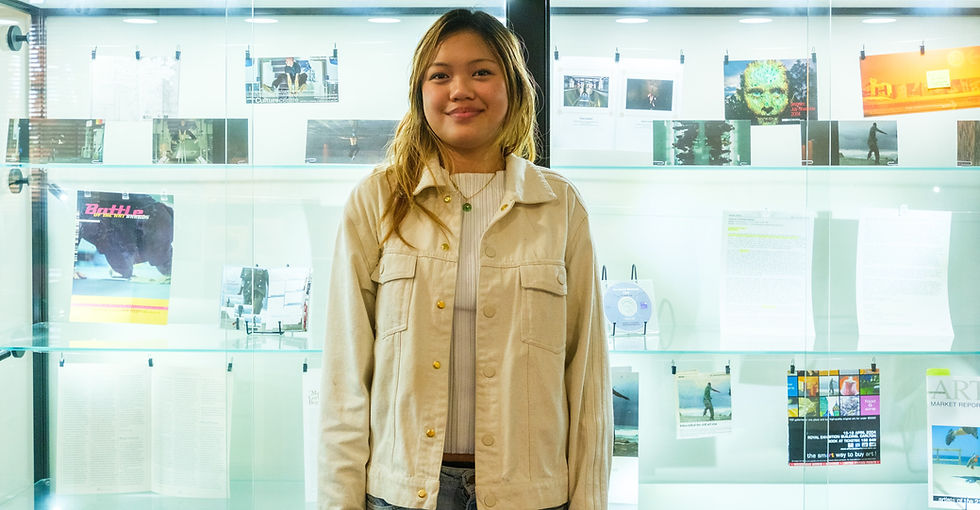
Fiona is studying a Bachelor of Arts (Media and Communications)/Advanced Studies.
This semester I had the opportunity to undertake the Library Research and Metadata Internship at the Schaeffer Fine Arts Library through FASS3000, where I explored the archival predicament in capturing metadata that would most accurately translate the fluid ephemerality of performance video art practices into the rigidities of material documentation.
After three years of art history research and essay writing, my experience in the GLAM sector remained largely theoretical. The hands-on work in the Schaeffer Fine Arts Library internship provided valuable experience in working closely with the Sherman Gallery Archives, cataloguing a diverse range of artist catalogues, press releases, invitations and critical articles. This expanded my art historical knowledge in exposing me to the reality of how art institutions preserve, organise and interpret cultural memory through the archival frameworks that surround art. Only through executing this labour myself, was I able to recognise that archival processes are never neutral but instead, shaped by human judgement, institutional priorities and classification systems.
When cataloguing a set of Shaun Gladwell exhibition invitations and press materials ranging from the early 2000s to retrospective articles, the impact of seemingly small classificatory choices were foregrounded. Deciding what information to include in the description of the materials in the archival interface, Hypatia, would produce very different narratives; whether emphasising the evolution of the artist’s engagement with performance or to highlight the Sherman Gallery’s long term investment in his career. In drafting a short description for each item required me to determine which aspects of Gladwell’s practice, in his use of skate culture, his video installations, his interest in embodied movement, were highlighted. This archival process therefore revealed that fallible notion of objectivity and passivity in the act of cataloguing.

Figure 2: Exhibition on display at Schaeffer Library Exhibition Space
The issue archives face in attempting to pose a universal language to accessing knowledge is revealed by Charles Cutter in his essay “Objects and Means” (1904), "Some subjects have no name; they are spoken of only by a phrase or by several phrases not definite enough to be used as a heading.” If what is considered as “universal” represents the needs and desires for mass culture, and that culture remains in perpetual change, then the “universal” must likewise be a state of flux. However, the archivist’s perceived fidelity to the past renders it slower to the world it aims to document and catalogue.
The artists represented in the Sherman Gallery, of whom I have been recording the metadata facsimiles and catalogues of, represents the tastes of Eurocentric institutions, focalising Western and East Asian art; genres that have historically been represented in curatorial hierarchies. Therefore in the Sherman Gallery archive, the language utilised in metadata reflects Foucault’s notion that knowledge is a system of control that produces meaning, rather than merely recording it. Whilst the 1990s saw the birth of historical revisionism and a revisitation of the Western canon, writers were still referring to Japan in exoticising terms; referring to culture as “the orient” and flattening the depth of minimalism with all its Buddhist philosophies to the term “zen”. Therefore, this experience underscored the complicity of archives in perpetuating hierarchies of knowledge and taste; hierarchies that are predicated on the exclusion of underrepresented genres from regions outside of economic power.
If Shaun Gladwell’s video art expanded the definition of “fine art” (his work Storm Sequence (1999) being the first video art installation to be sold in the Australian art market), then how are we to catalogue art that will not be accurately represented by present archival description? Being the gatekeepers of knowledge to the domain of art historical scholarship, archival labour presents a distinct site of tension between the past and the future; what ceases to be, sentencing material to the past, and what will be, in archiving for future scholarship. This phenomena occurs at once in a non-linear time continuum, dialectical opposites in constant feedback.
Simultaneously undertaking the Schaeffer Fine Arts Library internship and continuing my studies in Art History has thus revealed a reciprocal relationship between library cataloguing and scholarship; that the archivist and art historian must defer to one another in order to articulate progression in codified forms of common practice, and shape their disciplinary boundaries.
I am grateful to the Schaeffer Fine Arts Library team for their expert guidance, support and the Power Institute for the opportunity to engage so closely with the Sherman Gallery Archives. Beyond enriching my understanding of archival practice and art historical research, this internship has provided invaluable insight into the human labour and ethical considerations that shape how knowledge is preserved and transmitted. Thank you to Sajid, Nick and the team for creating an environment that fostered critical reflection and hands on experience in the GLAM sector .


Comments