


Working with the Archive: Systems and Silences. By Isabel Wadeson-Lee

Part of a series of student articles for the Schaeffer Fine Arts Library Internship Program
Find out more about our Master of Art Curating or Master of Museum & Heritage Studies
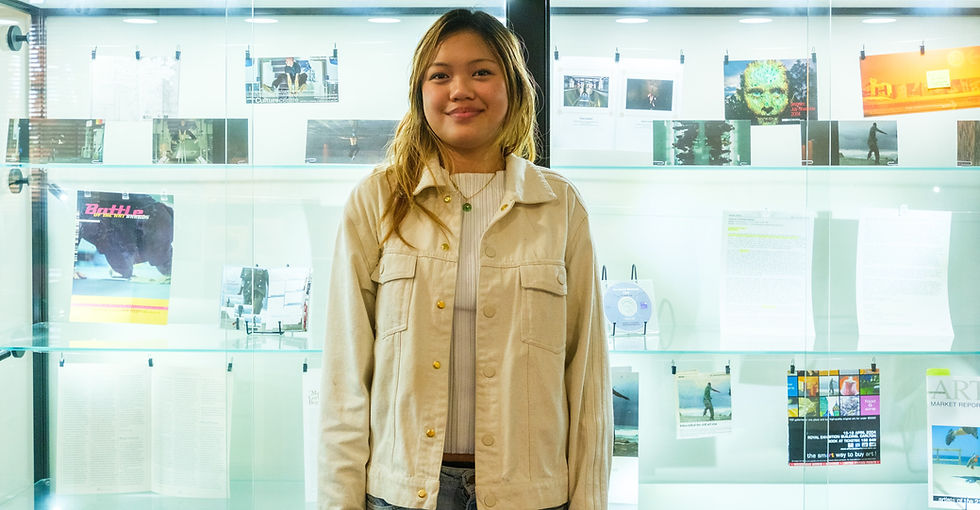
As a research and metadata intern at the Schaeffer Fine Arts Library, I worked with the Sherman Galleries Archive on a project that involved cataloguing records from artist folders alongside curating an exhibition to showcase the collection. The records in the Sherman Galleries Archive are extensive, ranging from exhibition catalogues, invitations, and speech notes from opening nights to art criticism in the form of press clippings and journal articles, as well as personal correspondence, artists’ resumes, and photographs.
At first glance, these materials might appear supplementary to the primary output of an artist’s practice – artworks – yet as I progressed, I realised how fundamental this ephemera is to the arts ecology as a whole, shaping how artistic value is constructed and communicated.

Cataloguing these records allowed me to appreciate how the role of an archivist is not simply administrative, but interpretive. Each catalogue entry acts as a snapshot of the record in its entirety, and capturing metadata and entering it into the library database requires decisions to be made about what information to extract and what language to use, so that it is accurate, consistent, accessible, and meaningful. Looking ahead, the needs of potential researchers had to constantly be anticipated, and in this vein, knowledge preservation becomes a negotiation between past, present and future.
Physically handling these archival records afforded me a real sense of connection to time and place. Inclusion in the archive has a historicising effect for both the artist and the institution - it situates artistic production within both international and local contexts.
The majority of the material I interacted with originated from the late 1980s to mid 2000s, offering a glimpse into not only the trajectory of artists’ careers but also into the broader creative economy of this period. Yet part of the archive’s charisma is that these fragments of time and place lend themselves to a larger story, and assembled together they generate an overarching narrative that wears a cloak of objectivity. As Harris observes, “The archival record…is best understood as a sliver of a sliver of a sliver of a window into process. It is a fragile thing, an enchanted thing, defined not by its connections to 'reality', but by its open-ended layerings of construction and reconstruction.” (Harris 2002, p. 151). That is not to say the archive does not contain ‘truths,’ but that its gaps, or silences, can offer as much insight as its content.
When working with the archive to create an exhibition, connections between the cataloguing and curatorial processes became clear, as each involves acts of selection, description and interpretation, forming a picture of the artist and the artwork that is far from neutral, as it is grounded in institutional frameworks. I chose to create an exhibition from records relating to the artist Clinton Naina[1] (Meriam Mer, Ku Ku), titled Visual Language, Archive, and Identity in the Work of Clinton Naina. While other artist folders contained more comprehensive records, I was drawn to Naina’s work for its interrogation of cultural normativity and mainstream heritage. The archival records I selected for display highlight Naina’s examination of colonial legacies in language, colour, and product branding.
These bodies of work draw out the complexity in relationships between Indigenous and non-Indigenous cultures, and their respective inheritances, asking: whose heritage is being represented, who is positioned as the ‘other’ and how are myths of national identity and asymmetrical power structures embedded in the vernacular of Australian culture. Naina conveys frustration, passion, humour, and at times, a wry eroticism, through his own distinct voice. As the exhibition draws heavily on catalogues, reviews, and press articles, and by necessity does not feature any artworks in the flesh, this is an interesting curatorial position to be in, illustrating how visual language is mediated through secondary sources.

As I gained familiarity with the concepts and histories underpinning Naina’s practice, the limitations of archival description became increasingly apparent. I was working with materials that referenced Indigenous epistemologies, and standardised metadata fields can struggle to contain forms of knowledge that are relational or embodied. This created a more heightened awareness of how systems of classification are, by nature, deeply political.
I also began to reflect on the prevalence of archival material relating to the artist’s career as a painter, in comparison to the marginal presence, or complete absence, of material that documented the more intangible aspects of the artist’s oeuvre. Naina is described as a painter, dancer, storyteller, and performer, yet this plurality is not reflected in the archive. These omissions could be chalked up to other factors – the relative stability of paper-based texts compared to audiovisual recordings, the art market’s preference for more concrete, saleable media such as paintings, the intangible falling outside traditional definitions of art, or perhaps it was simply the artist’s wish that these performances remain ephemeral.
Nonetheless, this led to a more complex understanding of how the archive’s structure privileges certain types of material over others – and historically, certain kinds of voices over others. As Carter outlines, “The power of the archive is witnessed in the act of inclusion, but this is only one of its components. The power to exclude is a fundamental aspect of the archive. Inevitably, there are distortions, omissions, erasures, and silences in the archive. Not every story is told” (Carter 2006, p. 216). The role of an archivist, curator, or researcher then becomes all the more critical, requiring a commitment to truth-telling principles and an intimate understanding of professional responsibility.
Ultimately, this internship experience at the Schaeffer Fine Arts Library allowed me to see how archival practice is not fixed, but continually unfolding. The archive can act as a site of possibility, creating conduits between past and present. More than simply a repository for preserving social and institutional memory, it can represent a space for tension, dialogue, and negotiation between different ways of knowing.
References
Breakell, S. (2015) 'Archival practices and the practice of archives in the visual arts', Archives and Records, 36(1), pp. 1-5.
Carter, R. G. S. (2006) 'Of Things Said and Unsaid: Power, Archival Silences, and Power in Silence', Archivaria, 61(61), pp. 215-233.
Harris, V. (2002) 'The Archival Sliver: A Perspective on the Construction of Social Memory in Archives and the Transition from Apartheid to Democracy', in Hamilton, C., Harris, V., Taylor, J., Pickover, M., Reid, G. and Saleh, R. (eds.) Refiguring the Archive. Dordrecht: Springer Netherlands, pp. 135-160.
Lester, P. (2024) 'Art and archives in the gallery: the archivist’s perspective', Museum Management and Curatorship, 39(5), pp. 576-591.
Mbembe, A. (2002) 'The Power of the Archive and its Limits', in Hamilton, C., Harris, V., Taylor, J., Pickover, M., Reid, G. and Saleh, R. (eds.) Refiguring the Archive. Dordrecht: Springer Netherlands, pp. 19-27.
[1] Formerly known as Clinton Nain.


Comments