


Networks of Presence: Hilarie Mais Artist Collection: By Shiqiao Zhang

Part of a series of student articles for the Schaeffer Fine Arts Library Internship Program
Find out more about our Master of Art Curating or Master of Museum & Heritage Studies
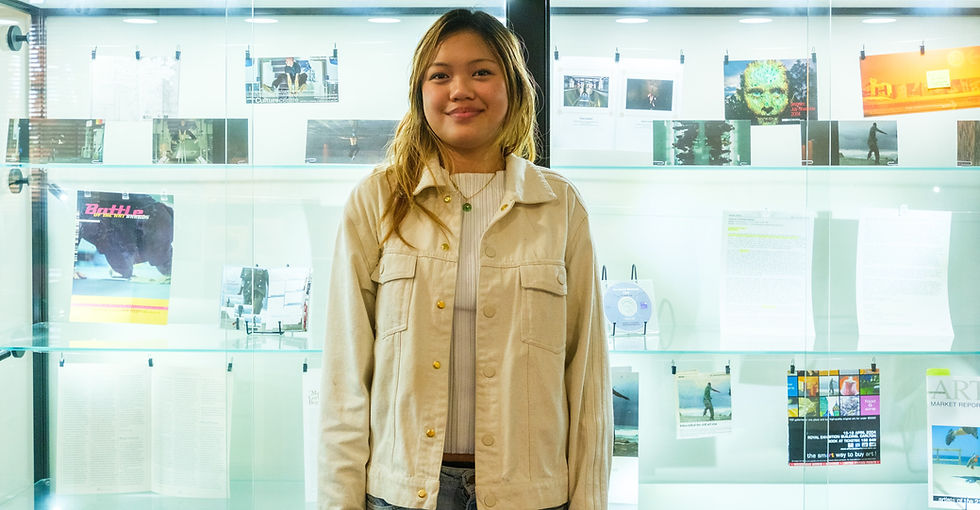
Through the GLAM6910 Capstone Internship Program, I had the opportunity to undertake an internship at the Schaeffer Fine Arts Library. During my placement, I participated in research and metadata entry work and, with the support of the library team, curated a small exhibition based on archival materials donated by Sherman Galleries. focussing on the artist Hilarie Mais. I gained a great deal from this experience.
After Sherman Galleries closed in 2006, Dr Gene Sherman donated 137 folders to the Power Institute in 2010. The folders contain a rich variety of materials, including exhibition catalogues, invitations, newspaper clippings, magazine articles, promotional materials, photographs, and administrative documents. Originally, these materials served practical purposes. However, over time, as exhibitions came to an end and the materials were reorganised, they acquired new meanings. They were no longer simply documents left behind after an exhibition. Instead, they became important clues for understanding artists’ careers, exhibition histories, and Sydney’s artistic networks. By preserving these materials and later donating them to the Power Institute, Sherman Galleries ensured that many details that might otherwise have been overlooked were not lost, forming a valuable network of memory.
At first, metadata entry felt repetitive and tedious, as I spent entire days working with computers and folders. However, as more data was entered and more materials were examined, the artists’ names and works recorded in the archival folders were no longer simply pieces of yellowing paper or uninteresting information. They gradually became vivid and alive. I began to learn more about the artists’ pasts, the stories behind their creative practices, and the deeper reasons why they developed their distinctive artistic styles.
Among these artists, Hilarie Mais particularly captured my attention, not only because of her artworks, but also because of the changes in her artistic style and the stories behind them.

Mais was initially influenced by geometric abstraction and minimalism, developing her practice in the United Kingdom and New York. Her early works often used steel and simple lines as their main elements. After moving to Australia in 1981, her work gradually shifted towards themes of plants, growth, fertility, and women’s experiences, influenced by Sydney’s natural environment and her experience of her first pregnancy. Her use of colour also became brighter. By the mid-1980s, the grid had gradually become a central element of Mais’ work. Her works became increasingly difficult to classify simply as paintings or sculptures, instead occupying a space between the two.
Mais gave the grid more personal meanings. In her later practice, she continued to reinterpret the grid. It was no longer simply a geometric structure, but also became a form capable of expressing emotion and memory. Mais’ works made me realise that an apparently simple and repetitive visual language can gradually accumulate complex and rich meanings through an artist’s life experiences.
While organising the materials, I discovered that a past exhibition is often accompanied by a large number of archival records produced by different institutions, cities, and professional fields. I became more familiar with Sydney’s art scene and realised that an exhibition involves far more than the artworks displayed in a showcase. It also involves the artists, audiences, critics, galleries, newspapers, magazines, and other organisations connected to the circulation of art.
These materials do not exist in isolation. They are interconnected, forming a network of relationships around artistic creation, exhibition-making, and circulation. These discoveries gradually led me to develop the central theme of my exhibition: 'networks.'

By the end of my placement, I had catalogued materials relating to three artists across seven folders, creating 382 database records. This work allowed me to develop one of the essential skills required for behind-the-scenes library work. When entering archival records, I often needed to search for related information and verify artists’ backgrounds, exhibition details, publication titles, dates, and other information. This made me more familiar with relevant organisations in the arts and cultural sector in Australia, especially in Sydney. As an international student, I might rarely have actively encountered or learned about some local magazines, newspapers, and traditional festivals without this placement experience. Rather than simply entering individual pieces of data, I was gradually learning about the culture of a city through these seemingly fragmented pieces of information.
This experience also changed my understanding of behind-the-scenes library work. As a Museum and Heritage Studies student, I had learned in class about the importance of collection registration and the consequences that can result from incorrect practices. After putting these ideas into practice in the library, I developed a deeper understanding of the theories discussed in the readings. In the past, I might have regarded metadata entry as a repetitive administrative task. However, after taking part in the work myself, I realised that every accurate record provides a foundation for future research and public use. If an artist’s name, an exhibition date, the name of an institution, or the type of material is not clearly recorded, the archival item may be difficult to find again and difficult to use effectively. Even an apparently ordinary invitation card, administrative email, or newspaper article may become an important clue for understanding an artist’s career, exhibition history, and the circulation of art.
Similarly, cataloguing is not a completely neutral process. Staff members need to decide how to describe an item, which information to record, and how to present the connections between different documents. These small decisions can influence how future researchers understand the archive and which stories are more likely to become visible.
Looking back on my placement, my greatest achievement was not only developing practical skills in metadata entry, research, and archival organisation, but also gaining a deeper understanding of the significance of behind-the-scenes work in libraries, archives, and museums. Many seemingly ordinary documents can only be rediscovered in the future and become valuable clues for understanding artists, exhibitions, and urban culture when they are carefully preserved, recorded, and organised over time.
Through curating this exhibition, I also came to realise that art never exists in isolation. Its meanings continue to accumulate through processes of creation, exhibition, criticism, circulation, preservation, and reinterpretation. As the theme of this exhibition, 'networks,' suggests, artists, galleries, libraries, researchers, and audiences all participate in this process and collectively form part of art history.
Finally, I would like to thank Sajid and Nicholas, both of whom have worked at the library field for many years. I am grateful for your patient guidance, assistance, and support throughout my placement, and for the opportunity to work with archival materials, participate in library work, and independently curate an exhibition. This experience has given me a clearer sense of the direction in which I hope to continue learning and developing within the fields of museums, libraries, and cultural heritage.


Comments