


Yuki Kihara: Memory, Media and the Ethnographic Archive By Jun Kwoun

Updated: Aug 18
Part of a series of student articles for the Schaeffer Fine Arts Library Internship Program
Throughout my internship at the Schaeffer Library, I was drawn to the abundance of ‘voices’ — of art critics, journalists, academics, and gallery workers — that ultimately come together to produce an archive.
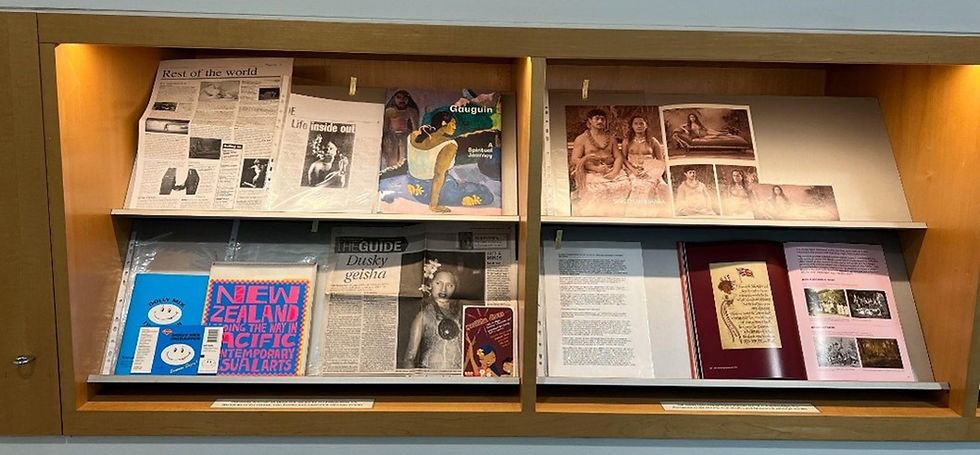
Sherman Gallery exhibition catalogues, assorted exhibition notices from other galleries, art criticism, news clippings, photocopies of news clippings and two published books related to the artist.
An archive is never neutral; it is shaped by the decisions, priorities and omissions of those who construct it. Over time, these accumulated perspectives determine not only what is physically preserved, but whose stories are told and whose are silenced.
For my final project as an intern, I was given the freedom to curate a small exhibition in the library. My display, Rewinding the Archive: Yuki Kihara and the Ethnographic Archive, features a collection of files from the early 2000s drawn from contemporary multimedia artist Shigeyuki Kihara, popularly known as Yuki Kihara. The final exhibit features a range of media clippings, exhibition catalogues and portraits that speak to the artist’s vibrant involvement in the Asia-Pacific art scene, as well as the development of her distinctively camp, tongue-in-cheek practice spanning performance art and photography. The catalogue and speech notes for Kihara’s influential work, Fa'afafine: In the Manner of a Woman, are also included, in which she restages photographs from the nineteenth and twentieth centuries to reveal the erasure of queer identities from the colonial archive.
Hal Foster famously describes the “archival impulse” in contemporary artmaking which emerged from a desire to challenge exactly the authority and cohesiveness that typically characterises historical collections. Kihara shows that the archive is a space in a constant state of being reinterpreted and rearranged, and in fact it is only by understanding how certain items were archived — by whom, and for what purposes — that we can begin to interpret what a corpus actually represents. For this reason, archives necessarily present art historians with issues of historical truth and archival practices that fail to consider issues of coloniality risk misrepresenting or erasing identities in the historical narrative.
Ultimately, the internship provided significant experience in art historical practice that I would not otherwise have accessed during my Bachelor’s degree, as I oversaw the drafting, construction and presentation of my exhibition, including writing the wall text, and selecting which items to display. In addition, the open display of the exhibition space pushed me to consider new ways of presenting archival materials in order to promote audience interaction and access.
It is clear that archival practices are being challenged and reinvented, as both artists and sector professionals recognise the archive as an active site of narrative production rather than merely a record of historical fact. Kihara’s practice of ‘restaging’ makes this especially clear: by inserting her image into the colonial record, not only does she point to past omissions, but she suggests that there is potential for archives to reflect the rich realities of identity today.


Comments