


Rememory: Reflections in Zines. Exhibition at Schaeffer Fine Art Library

By Dr Yvonne Low, Unit Coordinator of ARHT6936 Biennales, Triennales and Contemporary Art
The zines created by Art Curating students are on display in an exhibition at the Schaeffer Fine Arts Library from now until the end of August. The digital zines may be viewed here. Find out more about studying Art Curating in the Discipline of Art History at the University of Sydney.

“What I found particularly rewarding about the process of creating the zine was the opportunities to integrate creative visual design with the writing process itself, and to consider form and materiality in the context of developing innovative, engaging resources for exhibition audiences.” — Sarah Clayton
We are delighted to present an inaugural exhibition of zines made by students in ARHT6936, Biennales, Triennales and Contemporary Art, a unit offered as part of our Master of Art Curating program. The zines are currently on display in the exhibition area on the entrance level of Schaeffer Fine Art Library, and were made in response to the 25th Biennale of Sydney. The Biennale takes its title, Rememory, from Toni Morrison: a word for the way recollection becomes an act of reassembling fragments of the past, and for the point where memory and history meet, where erased or repressed narratives can be revisited and reclaimed.

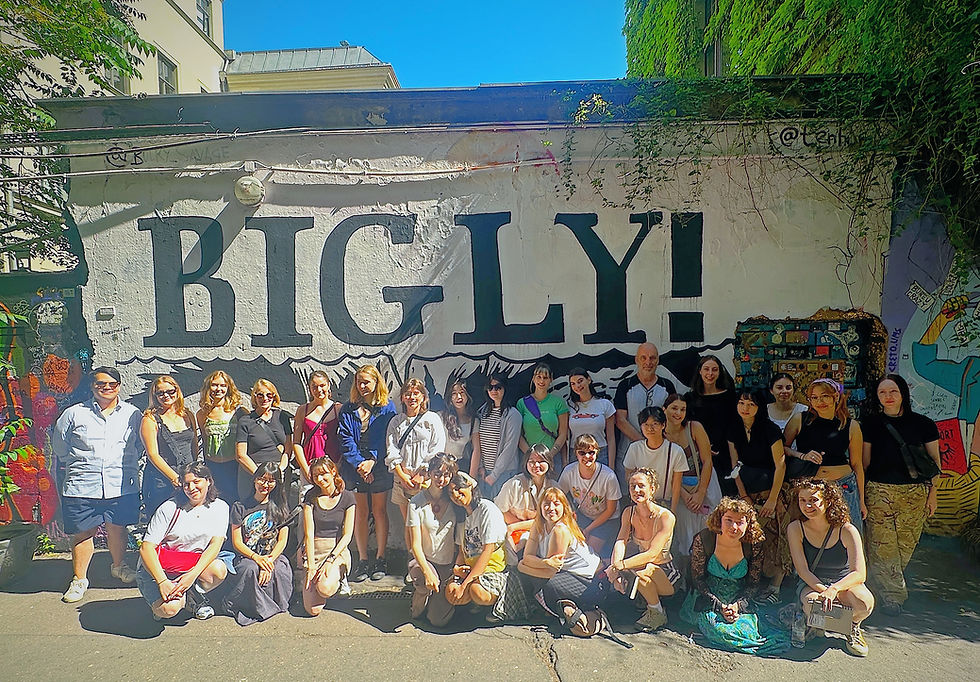
The Art Curating unit, Biennales, Triennales and Contemporary Art, runs alongside the Biennale itself, and students spent the semester on site — at the Chau Chak Wing Museum, the Art Gallery of New South Wales, White Bay Power Station and Campbelltown Arts Centre. For their major project, I asked them to respond to the Biennale's theme in a zine: to make an argument through form and design as much as through words.
It is a deceptively hard thing to do because you have to decide what goes on the back of a card (or what stays folded away!); in fact, what you put into a reader’s hands and what you hold back — these choices serve to perform the arguments as well.

The results have been remarkable. One zine makes the case that collaborative works produce slowness differently, through small private acts of handling, waiting and listening. Another asks whether curated disorientation, even where it is driven by decolonising aims, ends up making meaning available mainly to those already fluent in the language. One other sketches native plants over old maps of Sydney. The zines draw on students’ own field notes so that personal and institutional voices end up side by side on the page.
Maria Karageorge, who marked the work, was struck by the range of it. “Making a zine requires you to build an argument out of an original encounter,” she says, “and the range of arguments students produced was remarkable. Some used flower imagery to draw out matrilineal systems of knowledge and questions of gender; others turned to native botany to trace different lines of meaning. No two zines arrived at the same place, because no two students had started from the same question.” Her thoughts: “
The zine is not just an assessment format, but a genuine creative methodology for critiquing an exhibition as complex and layered as the Biennale of Sydney.”
The students found much the same thing.
“Academic work is not always to be confined to and presented in a standard white document! Swapping a conventional essay for a zine meant our communication was more evocative, felt, and remembered.” — Jason Jang
“At first the experience was chaotic — trying to figure out which road to go down while creating my zine booklet. Once I found the idea, the creativity began. Creating my zine booklet was a fantastic experience, and having it displayed in the Fine Arts Library is a proud moment.”— Rebecca Thomas
Half the pleasure is in the handling: the concertina folds, the paper cut-outs that is sometimes unexpected, the little notes tucked into envelopes (and more). So do come and see them in person.
We extend our sincere thanks to Anne Goodfellow, Cultural Collections Librarian, and to the team in Rare Books and Special Collections, whose workshop on zine-making and introduction to the library’s own zine collection were a genuine source of inspiration for this work. With thanks also to the Schaeffer Librarians and to Dr Katrina Grant for their support of the physical and digital exhibitions respectively.


Comments